
Metformin is one of the most widely prescribed and well-studied medications for Type 2 diabetes, PCOS, and insulin resistance. It’s effective, affordable, and generally very safe, which is why millions of people take it daily for years.
But there’s one clinically important issue most people discover too late: Metformin can significantly reduce Vitamin B12 levels over time.
This isn’t a minor side effect. Persistent B12 deficiency affects energy, mood, metabolism, nerve health, cognition, gut function, and in severe cases, can even lead to permanent nerve damage.
And what makes it tricky? It develops slowly and looks like “normal tiredness” so people rarely connect the dots.
Let’s unpack what the science says, why it happens, who’s at risk, and how to protect yourself without stopping metformin.
What Does Vitamin B12 Actually Do? (And Why You Really Need It)
Vitamin B12 (cobalamin) is essential for:
Red Blood Cell Formation
Low B12 → large, defective RBCs → anemia, fatigue, low stamina, palpitations.
Nerve Function
B12 maintains the myelin sheath (the insulation around nerves).
Deficiency → tingling, numbness, nerve pain, burning feet, balance issues.
Brain & Mood Health
Low B12 affects neurotransmitter synthesis → poor memory, low mood, brain fog, irritability.
Homocysteine Regulation
B12 helps recycle homocysteine → high levels = increased cardiovascular risk.
Energy Metabolism
No B12 = impaired mitochondrial function → low energy despite eating well.
This is why B12 deficiency can masquerade as “stress” or “weakness,” but physiologically, it’s much deeper.
How Metformin Causes Vitamin B12 Deficiency
Metformin doesn’t “use up” B12.
Instead, it interferes with the way your gut absorbs it.
Here are the main mechanisms science points to:
Reduced Absorption in the Ileum
B12 is absorbed in the terminal ileum through a receptor called cubilin.
Metformin decreases the expression and activity of these receptors.
Fewer receptors → less absorption → declining stores.
Altered Calcium-Dependent Uptake
B12 absorption is calcium-dependent.
Metformin reduces calcium availability in the gut.
Less calcium → impaired B12-Intrinsic Factor complex uptake.
(Some studies show calcium supplementation may partially reverse this effect.)
Metformin Alters Gut Motility & Microbiota
Long-term use changes gut bacteria and motility patterns → This impacts nutrient absorption including B12, folate, and iron.
Higher Risk with Higher Doses & Duration
Clinical data consistently shows:
- Higher dose (≥1000–2000 mg/day)
- Long duration (≥2–5 years of use)
= greater risk of B12 depletion.
This is why B12 deficiency is not immediate. It creeps in slowly.
How Common Is B12 Deficiency in Metformin Users?
Research estimates:
- 10–30% of people on long-term metformin develop low or borderline B12.
- Risk rises to 40% or more in elderly patients or those with poor dietary intake.
- PCOS patients often go unnoticed because their symptoms overlap with deficiency.
We aren’t talking about rare cases, this is common and clinically important.
Symptoms to Watch Out For
Metformin-related B12 deficiency can present subtly.
Neurological Symptoms
- Tingling or numbness in hands/feet
- Burning feet syndrome (very common in diabetics)
- Reduced reflexes
- Balance difficulty
- Nerve pain
Mental & Cognitive Symptoms
- Brain fog
- Memory lapses
- Irritability
- Low mood or mild depression
Fatigue & Metabolic Symptoms
- Constant tiredness
- Weakness
- Reduced exercise capacity
Hematological Symptoms
- Pale skin
- Palpitations
- Shortness of breath
- Megaloblastic anemia
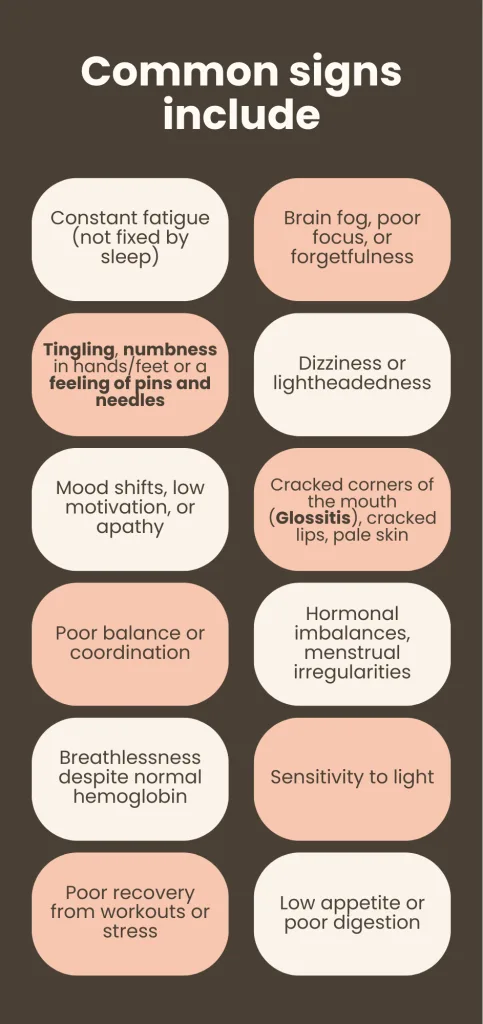
These symptoms are often blamed on diabetes or stress but correcting B12 can dramatically improve them.
Who Is Most at Risk?
You have a higher risk of deficiency if you:
- Take >1000 mg/day of metformin
- Have been taking it for 2+ years
- Follow a vegetarian or vegan diet
- Have gut issues (IBD, celiac, atrophic gastritis)
- Are 50+ years old
- Take acid-reducing medication (PPIs, H2 blockers)
- Have low protein intake
- Have existing peripheral neuropathy
If two or more apply, B12 monitoring becomes essential.
What Tests Should You Do? (And How Often?)
Simply checking “Vitamin B12” is not enough in many cases.
Recommended blood tests include:
- Serum Vitamin B12
- Normal: ~300–900 pg/mL
- Borderline: 200–300 pg/mL
- Low: <200 pg/mL
- Methylmalonic Acid (MMA)
- The most sensitive marker of true B12 deficiency.
- High MMA = intracellular B12 deficiency.
- Homocysteine
- Elevated when B12 or folate is low.
- Complete Blood Count (CBC)
- Checks for enlarged RBCs (macrocytosis).
How often to test:
- Once a year for all metformin users.
- Every 6 months if you already have low levels or symptoms.
Correcting B12 Levels: Diet + Supplements + Monitoring
Dietary Sources of B12
Since B12 is naturally found only in animal foods, good sources include:
- Eggs
- Milk & curd
- Paneer
- Fish
- Chicken
- Fortified cereals/plant milk (varies by brand)
Apart from diet, there is also an option for supplementation.
Supplementation: What Works Best?
Oral Cyanocobalamin or Methylcobalamin
1000–1500 mcg/day works for most mild cases.
Sublingual B12
Useful if absorption is impaired. Bypasses the gut.
Injectables (Methylcobalamin or Hydroxocobalamin)
Recommended if:
- Levels are very low
- Neuropathy is present
- Oral supplements don’t raise levels
Typical regimen:
- Weekly for 4 weeks
- Then monthly for maintenance
Important:
You do not need to stop metformin to correct B12 deficiency.
Should You Take B12 Preventively if You’re on Metformin?
Many diabetes associations now recommend preventive B12 testing and supplementation, especially for long-term users.
Given the extremely low risk of toxicity (B12 is water-soluble), preventive supplementation is considered safe and beneficial for most.
The Bottom Line
Metformin is a fantastic medication but like everything, it comes with responsibilities.
If you’re taking metformin long-term, monitoring and maintaining your B12 levels is not optional. It’s essential.
Unchecked B12 deficiency can impact your nerves, brain, energy, and long-term metabolic health but with the right testing and supplementation, it’s entirely preventable.
Your health doesn’t have to pay the price for your medication.
With awareness, routine monitoring, and timely supplementation, you can fully enjoy the benefits of metformin without the hidden risks.
If you’re exploring a more personalised way to support your health, explore the diet programs designed for different goals, curated with clinical precision.
0 Comments